An effective treatment with an established safety profile for an infantile hemangioma
The First and Only FDA-Approved Treatment for a Proliferating Infantile Hemangioma Requiring Systemic Therapy.

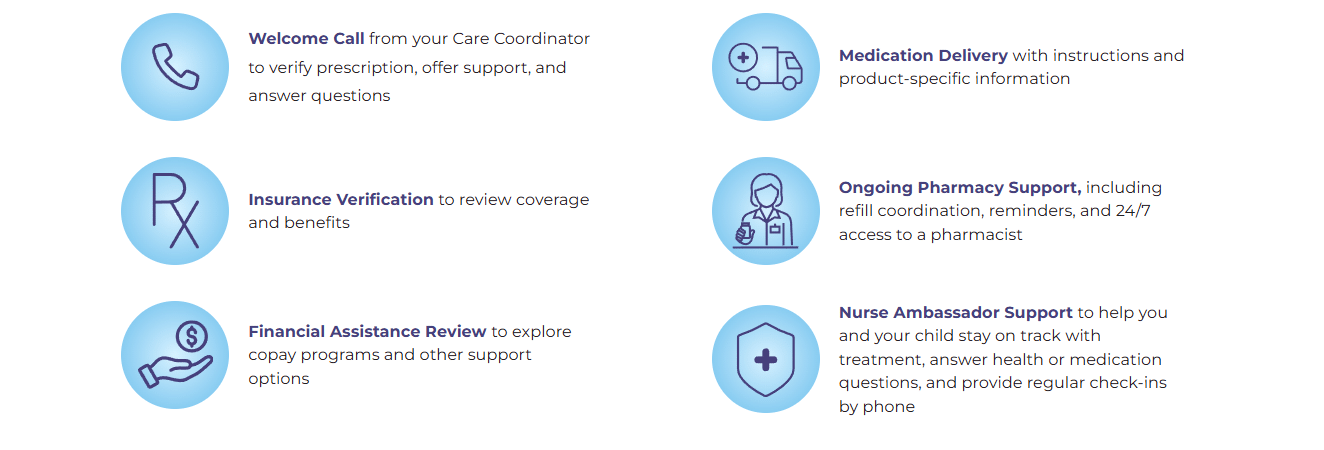
When your doctor prescribes HEMANGEOL, you’re automatically enrolled in the Eton Cares Program®—designed to support you and your family every step of the way.
copay*
*Restrictions, limitations, and/or eligibility requirements may apply.


When your doctor sends your prescription to our specialty pharmacy Anovo, this is what you can expect:
The HEMANGIOM' APP
For Education and Treatment Adherence when Caring for HEMANGEOL Patients
Hemangiom’App is a digital version of the caregiver guide, designed to help you manage your infant’s treatment plan with support and guidance.
This app is intended for the exclusive use of caregivers 18 years and older. The Hemangiom’ App is not intended to provide treatment decisions or replace the care and advice of a licensed healthcare provider. If you have any questions about this information, be sure to discuss them with your healthcare provider.

What is an Infantile Hemangioma?
Infantile hemangiomas, sometimes called “strawberry marks,” are benign tumors formed from the overgrowth of blood vessels on or under the skin.
You often can’t see infantile hemangiomas when your baby is born. It may appear after a few weeks.
All infantile hemangiomas go through phases of early rapid growth (proliferation) then slowly start to improve over a span of up to 9 years.

Understanding An Infantile Hemangioma

Learn About Hemangioma
Infantile hemangiomas, also known as IHs, are benign, blood-filled tumors that form due to the overgrowth of blood vessels.

Why and When to Consult?
In the vast majority of cases, the infantile hemangioma do not present any complication and disappear on their own. However, as soon as a lesion appears, do not hesitate to consult a physician, who will keep an eye on the hemangioma.

Advice for Parents
Since your baby has developed infantile hemangioma, you may be feeling confused, anxious, guilty, or concerned how others will react. The good news is there are support and advocacy groups dedicated to getting the help you and your family deserves.
Discover HEMANGEOL
- 60% of patients reached complete or nearly complete resolution of infantile hemangioma by 6 months versus 4% of patients on placebo (n=101)1
- 88% of patients on HEMANGEOL showed improvement after 5 weeks of treatment* (n=55)2
Clinically Proven Safe and Effective
Clinically proven safety and effectiveness profile
- 6 out of 10 of babies on HEMANGEOL had their infantile hemangioma lesion “completely or nearly completely resolved” by 6 months of therapy versus only 4% of babies given placebo (no treatment).
- 88% of patients on HEMANGEOL showed improvement after 5 weeks of treatment. Based on an independent investigator's assessment of telangiectasis, color, textural change, and distortion of anatomical landmarks or skin contours compared to baseline (n=55)
- Fewer than 2 out of 100 babies who were given HEMANGEOL had to stop treatment due to adverse experiences.
- More than 8 out of 10 babies treated with HEMANGEOL showed improvement after 5 weeks.
- HEMANGEOL can cause serious side effects, including low blood sugar (hypoglycemia), especially if your child is not taking feedings, or is vomiting. The most common side effects (>10%) include sleep problems, worsening respiratory tract infections, diarrhea, and vomiting.

Specifically Designed and Formulated for Babies
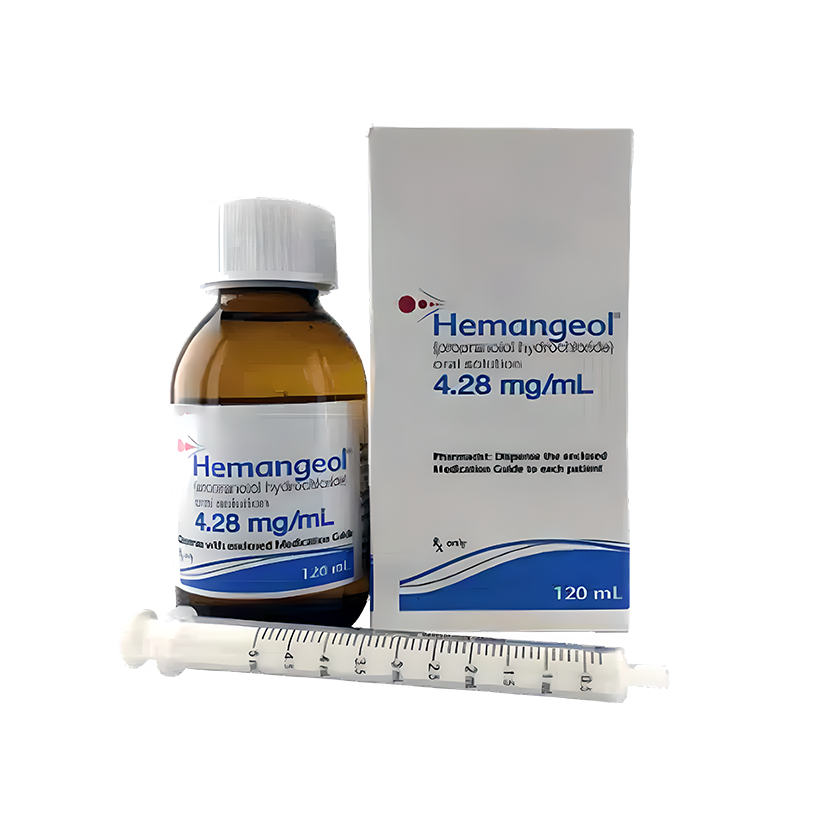
HEMANGEOL is a clear, colorless to slightly yellow oral-dosing solution supplied in a 120 mL amber glass bottle with a child-resistant screw cap. A specific oral syringe and syringe adapter are provided with each bottle. The oral dosing syringe measures HEMANGEOL according to volume in milliliters (mL).
HEMANGEOL is available in strawberry-vanilla flavor.
HEMANGEOL is:
- Alcohol-free
- Sugar-free
- Paraben-free

Questions For Parents
Infantile hemangiomas, sometimes called “strawberry hemangioma,” are benign tumors formed from the overgrowth of blood vessels on or under the skin. Infantile hemangiomas are the most common benign tumors of infancy—affecting up to 10% of all infants and up to 30% of premature babies. An infantile hemangioma (IH), for the most part, is not present at birth, though there can be a “pre-warning” outline (light red and subtly elevated) where a deeper, raised hemangioma will soon appear. A congenital hemangioma (CH) is different and is fully present at birth, though it can grow a little after birth.
In some severe cases, infantile hemangiomas can interfere with an important function:
- On the eyes, it can affect your baby’s vision, especially because eye development is crucial at an early age
- On the nose, it can affect your baby’s breathing
- On the mouth, it can affect your baby’s food intake
Some infantile hemangiomas are at high risk of bleeding, which can lead to anemia, blood transfusion, and/or infection. Infantile hemangiomas that are bleeding can also be extremely painful for your baby.
Some hemangiomas stop growing soon after they appear, but this is rare. Most hemangiomas go through a rapid growth cycle of 1 week to 16 weeks. The Infantile Hemangioma then seems to go quiet for a few weeks. From about 6 months to a year, there can be a little more growth. However, most of the growth occurs within the first 4 months. There are reports of hemangiomas growing past one year, but this is rare.
Babies fall and get bumps, cuts, and bruises all the time. A hemangioma, if cut, can be a scary mess. They bleed a lot because they are hyper-vascular. Direct pressure applied to the hemangioma will help the bleeding to stop. A little petroleum jelly and pressure bandage can be applied as well. If it continues to bleed the baby should be taken to pediatric Urgent Care.
Yes. No matter how big or how small, any lesion on the upper or lower eyelid can result in astigmatism or other eye complications if not treated immediately. The slightest pressure against the globe (eyeball) can reshape it and cause astigmatism. If your baby has an eyelid hemangioma, insist on treatment and discuss treatment options with your doctor and get regular pediatric eye exams.
Hemangiomas grow quickly and appear shortly after your baby is born. By the time your baby is 3 months old, the hemangioma growth will be 80% complete. However, infantile hemangiomas can grow until your baby is up to 6 months of age.3 Earlier treatment prevents faster and larger growth of the infantile hemangioma and lowers the risk of permanent scarring and disfigurement.
Note: Presented as general information only, and not medical advice. In all cases, it is important to consult with your physician regarding your particular case and treatment objectives.
Speak with your healthcare provider, or visit our Parent Resources for Infantile Hemangioma for more information.

Download the FAQ Guide of the Vascular Birthmarks Foundation using the button below. To learn more about the Vascular Birthmarks Foundation, visit their website.
The Vascular Birthmarks Foundation website is not owned or operated by Eton Pharmaceuticals. Links to all outside sites are provided as a resource only. Eton Pharmaceuticals accepts no responsibility or liability for the content or services of other websites.
What is HEMANGEOL
(propranolol hydrochloride oral solution)?
Download Important Patient Safety Information
Physician Discussion Guide
Making the Most of Your Office Visit
Talking to your baby’s doctor is very important. It can help you develop a better understanding of infantile hemangioma, the impact it may have on your baby, and the treatment options that are available.
2026 Eton Pharmaceuticals. 2567-v1